Taste the Sun: How Aswan’s Flavors Bring Its Natural Wonders to Life
Have you ever tasted a place and felt like you finally understood it? In Aswan, Egypt, the Nile’s golden light doesn’t just paint the sandstone cliffs—it flavors the food. From spice-laden markets to riverside meals under starlit skies, every bite connects you to the land. This isn’t just dining; it’s a sensory journey through one of nature’s most breathtaking stages. Here, where desert meets river and ancient stone rises from the earth, meals are more than sustenance—they are invitations to experience the soul of a region shaped by sun, sand, and centuries of cultural exchange. To eat in Aswan is to taste the rhythm of the Nile and the warmth of Nubian hospitality, all woven into dishes that tell stories older than memory.
Where Nature and Nourishment Meet
Aswan rests like a jewel along the upper reaches of the Nile, where the river slows and deepens before continuing its journey north. Surrounded by arid mountains, dotted with lush islands, and bordered by ancient granite quarries, this southern Egyptian city exists in a delicate balance between desert austerity and riverine abundance. The landscape is dramatic—rose-colored cliffs glow at dawn, while feluccas glide across waters that shimmer like liquid topaz. Yet beyond the postcard views lies a deeper truth: the environment shapes not only what grows here but how people eat, gather, and celebrate life.
The cuisine of Aswan is inseparable from its geography. The Nile provides fish, irrigation for date palms, and fertile pockets where vegetables thrive. The desert sun dries herbs and concentrates the sweetness in fruits. And the proximity to Sudan and the historical presence of the Nubian people have infused the local diet with bold spices, earthy grains, and slow-cooked stews that reflect a heritage of resilience and generosity. Meals are often simple, relying on fresh ingredients and time-honored techniques passed down through generations. But simplicity does not mean insignificance. Each dish carries the imprint of the land—whether it’s the smoky aroma of grilled perch caught at sunrise or the tang of sun-ripened tomatoes sliced beside a garden wall.
This connection between terrain and taste transforms dining into an act of discovery. When you sit down to eat in Aswan, you are not merely consuming food; you are engaging with a living culture shaped by climate, history, and community. It’s a reminder that true travel immersion begins not with sightseeing alone, but with the willingness to taste, to listen, and to share a table with those who call this radiant corner of the world home.
The Soul of Aswan: A Culinary First Impression
From the moment visitors step off the train or boat into Aswan’s warm embrace, the city announces itself through scent and sound. The air carries a rich tapestry of aromas—cumin roasting over open flames, flatbread puffing in clay ovens, and the faint sweetness of ripe dates mingling with woodsmoke. Near the waterfront, small food stalls buzz with activity, their counters piled high with golden falafel, plump koshari, and baskets of warm eish baladi. These familiar staples of Egyptian cuisine take on a distinct character here, elevated by local ingredients and the influence of Nubian culinary traditions.
Falafel, for instance, may be found blended with crushed fava beans alongside chickpeas, giving it a deeper, earthier flavor. Koshari—Egypt’s beloved comfort dish of lentils, rice, pasta, and tomato sauce—is often spiced with a touch more chili, a nod to the bolder palates of the south. But what truly sets Aswan’s street food apart is its foundation in regional produce. Nile fish, freshly grilled and seasoned with lemon and coriander, appears in sandwiches wrapped in pita. Dates from nearby groves, known for their caramel-like richness, are stuffed with nuts or swirled into pastries sold at market corners.
Food in Aswan functions as a silent welcome. Before any formal greeting, a vendor might offer a sample of honey-drenched baklava or pour a cup of strong, sweet tea. These gestures are more than sales tactics—they are expressions of generosity, deeply rooted in Nubian values of hospitality. For travelers, this early culinary encounter becomes a bridge to understanding. It softens the unfamiliar, eases the transition into a new culture, and begins the process of connection. In a place where language barriers exist, a shared meal speaks volumes. The first bite is not just nourishment; it is an invitation to belong, however briefly, to the rhythm of daily life along the Nile.
Breakfast with a View: Felucca Rides and Morning Flavors
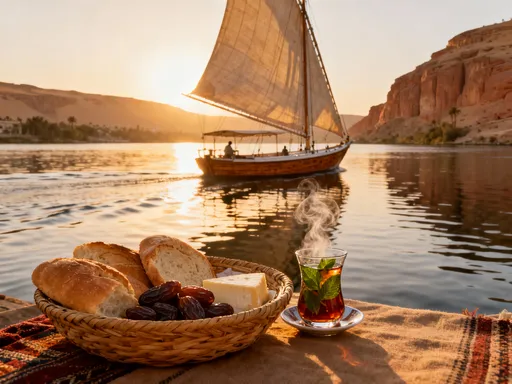
There are few experiences more quintessentially Aswan than beginning the day aboard a felucca, gliding silently across the Nile as the sun rises over the eastern bank. These traditional wooden sailboats, with their white triangular sails catching the morning breeze, offer a peaceful vantage point from which to witness the river awakening. As mist lifts off the water and ibises take flight from the reeds, passengers are often handed small glasses of steaming mint tea, fragrant and sweetened with cane sugar—a ritual that signals the start of a day shaped by nature’s pace.
Breakfast on the felucca is intentionally unhurried. A woven basket is opened to reveal a spread that feels both humble and abundant: rounds of warm eish baladi bread, creamy domiati cheese with a mild saltiness reminiscent of feta, plump green and black olives, and thick, golden honey harvested from hives kept on nearby islands. Sometimes, there’s a dish of ful medames—slow-cooked fava beans stewed with garlic, lemon, and cumin—served in a clay bowl still warm from the kitchen. Everything is eaten with the hands, enhancing the sense of intimacy and immediacy.
This morning ritual reflects a broader truth about Aswan’s food culture: it is deeply attuned to its surroundings. The ingredients are local, seasonal, and minimally processed. The pace allows space for conversation, for watching the light change on the water, for feeling the gentle rock of the boat. Unlike the hurried breakfasts of modern urban life, this meal honors stillness. It encourages mindfulness, not as a trend, but as a natural extension of living in harmony with the environment. To eat this way is to slow down, to notice the details—the crispness of the bread, the floral notes in the honey, the way the cheese melts slightly in the rising heat.
For many visitors, this felucca breakfast becomes a defining memory. It encapsulates the essence of Aswan: beauty found in simplicity, connection fostered through shared moments, and nourishment drawn directly from the land and river. It is not a performance for tourists, but a genuine reflection of how many locals begin their days—grounded, grateful, and in tune with the natural world.
The Spice of the South: Aswan’s Markets and Nubian Influence
No visit to Aswan is complete without wandering through its vibrant markets, where color, scent, and sound converge in a celebration of everyday abundance. The souks near the waterfront and in the older neighborhoods pulse with energy—vendors call out prices, children dart between stalls, and the air hums with the scent of roasting peanuts, dried limes, and freshly ground coriander. Piles of red paprika glow like embers, while saffron threads and turmeric powder are displayed in woven baskets, their golden hues mirroring the desert sun. Glass jars hold preserved lemons, pickled vegetables, and spice blends unique to the region, each with a story tied to family recipes and seasonal harvests.
At the heart of Aswan’s culinary identity is the enduring influence of the Nubian people, whose presence in the region dates back thousands of years. Displaced during the construction of the Aswan High Dam in the 1960s, many Nubian families resettled in villages along the river, bringing with them a rich gastronomic heritage. Their cuisine is characterized by bold flavors, the use of indigenous grains like millet and sorghum, and cooking methods that emphasize slow preparation and communal effort. One hallmark of Nubian cooking is mullah, a hearty stew often made with meat, vegetables, and a generous amount of ground peanuts, which lend it a rich, velvety texture and deep, nutty flavor.
Spices are used not merely for heat, but for complexity. Blends may include cumin, cardamom, cloves, and dried mango powder, creating layers of taste that unfold with each bite. These flavors are not accidental—they are the result of centuries of trade and adaptation. Aswan’s location near the border with Sudan made it a crossroads for caravans carrying goods from sub-Saharan Africa, the Arabian Peninsula, and the Mediterranean. Over time, ingredients and techniques merged, forming a cuisine that is both distinctly Egyptian and uniquely southern.
Today, visitors can sample these traditions in local homes, cultural centers, and even some riverside restaurants that proudly feature Nubian dishes on their menus. The market remains the best place to see this culinary fusion in action. Here, a woman might demonstrate how to toast millet over a small stove, while a spice seller explains the uses of za’atar or the difference between Egyptian and Sudanese cumin. These interactions are not just transactions—they are moments of cultural exchange, where food becomes a language of its own.
Dining Among Giants: Meals Near the Unfinished Obelisk and Quarries
On the west bank of the Nile, just beyond the city center, lies one of Aswan’s most awe-inspiring sites—the ancient granite quarries, where an enormous obelisk remains half-carved from the bedrock. Known as the Unfinished Obelisk, it stands as a testament to the ambition and engineering skill of ancient Egyptians. Intended to be the largest obelisk ever erected, it cracked during extraction and was abandoned, yet its sheer scale continues to inspire wonder. Surrounding it, the rock faces bear the marks of copper chisels and wooden wedges, silent witnesses to a time when human labor and divine purpose shaped the landscape.
Near this monumental site, it is not uncommon to see local workers or families gathered for a midday meal. Seated on woven mats or low stools, they break bread and share simple dishes under the shade of a tarp or tree. Their food is practical and nourishing—flatbreads baked that morning, lentil soup seasoned with cumin and garlic, hard-boiled eggs, and handfuls of dates for energy. Water is sipped slowly, often from glass bottles or metal flasks. There is no fanfare, no presentation—only sustenance drawn from the same earth that yielded the obelisk.
This contrast between the colossal and the commonplace is striking. While the obelisk speaks of power and eternity, the meal speaks of endurance and daily life. The workers’ diet is shaped by necessity—food that is easy to carry, long-lasting, and capable of sustaining体力 in the desert heat. Yet within this simplicity lies a quiet dignity. The same hands that once quarried stone for pharaohs now cradle bowls of soup with care, passing them from one person to another in a gesture of solidarity.
For visitors, pausing to eat in this setting offers a rare perspective. It reminds us that grand historical narratives are built upon the rhythms of ordinary existence. The laborers who shaped ancient monuments also needed lunch. Their meals, though humble, were essential. To share a similar meal—perhaps a packed lunch of ful sandwiches and fresh fruit—amid these ruins is to honor that continuity. It is to recognize that human achievement is not only measured in stone, but in the quiet acts of gathering, cooking, and eating together.
Sunset by the Nile: Rooftop Eats and Island Vibes
As the sun begins its descent behind the sandy hills of Aswan, the city transforms. The light softens, turning the river into a sheet of molten gold, and the air cools just enough to make outdoor dining irresistible. On rooftops and terraces, especially on Elephantine Island and along the riverfront, tables are set for dinner. Strings of lanterns flicker to life, and the distant sound of traditional music—perhaps a darbuka drum or a Nubian flute—drifts on the breeze. This is the golden hour of Aswan, when nature and nourishment come together in perfect harmony.
The evening meal often features some of the region’s most celebrated dishes. Grilled Nile perch, caught fresh that morning, is seasoned simply with lemon, garlic, and parsley, allowing the delicate flavor of the fish to shine. It is served alongside tahini-dressed vegetables—roasted eggplant, zucchini, and bell peppers—tossed with sumac and fresh herbs. A plate of koshari might appear for those seeking heartier fare, its layers of lentils, pasta, and spicy tomato sauce crowned with crispy fried onions. And for drink, komosha—a traditional Nubian beverage made from fermented millet—is sometimes offered, its slightly tangy, refreshing taste a perfect complement to the warm night air.
Dining in this setting is more than a meal—it is an experience for all the senses. The visual beauty of the river at dusk, the gentle lapping of water against boat hulls, the aroma of grilled fish and warm bread, the soft rhythms of music in the background—all contribute to a feeling of deep contentment. Conversation flows easily, laughter comes naturally, and time seems to stretch. There is no rush to finish, no need to check a phone or watch. The moment is enough.
Restaurants and guesthouses in Aswan have long understood this magic. Many design their spaces to maximize the view, with open-air seating, low lighting, and comfortable cushions. Some even host live Nubian music nights, where guests can listen to songs passed down through generations, their lyrics often speaking of love, the river, and the joys of shared meals. In these moments, the boundary between visitor and local blurs. Everyone is united by the beauty of the place and the pleasure of good food eaten in good company.
Cooking with Locals: A Taste of Home in a Nubian Village
One of the most meaningful ways to experience Aswan’s cuisine is by stepping inside a Nubian home. In villages like Gharb Soheil or Kenesa, where brightly painted houses with arched doorways line narrow lanes, cooking is a communal, open-air affair. Meals are often prepared in courtyards or under shaded pergolas, where women gather to chop vegetables, stir pots, and share stories. The kitchen may be a simple stove set on bricks, or a clay oven built into the wall, but it is the heart of the household.
Visitors invited to participate in a cooking session are welcomed not as tourists, but as guests. The process begins with a tour of the garden, where okra, mint, tomatoes, and papaya grow in abundance. Ingredients are picked fresh, sometimes still warm from the sun. The preparation of ful medames, a staple breakfast dish, is a lesson in patience and care—dried fava beans are soaked overnight, then simmered for hours in a heavy clay pot over low heat, stirred occasionally with a wooden spoon. Spices are added gradually, adjusted to taste, and the result is a creamy, aromatic stew served with bread and a sprinkle of chopped parsley.
Another common dish is hawawshi, a savory pastry filled with spiced ground meat, onions, and herbs, then baked until golden. The filling is mixed by hand, the seasoning tested on a small patty cooked quickly on the stove. Children might be tasked with rolling out the dough, while elders offer advice from a nearby chair. The atmosphere is warm, unhurried, and filled with laughter. When the meal is finally served, everyone eats together from shared platters, using bread to scoop up the food.
These experiences go beyond culinary education. They are acts of cultural sharing, where food becomes a vehicle for connection. The host family does not perform for an audience—they simply live their lives, generously including outsiders in their daily rhythms. For visitors, especially women who may relate to the roles of caregiver and cook, the experience can be deeply moving. It fosters empathy, understanding, and a lasting appreciation for a way of life that values community, tradition, and the simple joy of feeding others.
The Last Bite—Why Aswan’s Food Stays With You
Long after the photographs are sorted and the souvenirs packed away, a certain flavor lingers—the warmth of spiced bread dipped in olive oil, the sweetness of a Nubian date, the tang of komosha on a summer evening. These tastes do more than satisfy hunger; they anchor memory. While the pyramids of Giza may dominate postcards, it is often the meals in Aswan that remain most vivid in the mind. This is because true immersion in a place happens not only through sight, but through all the senses—and especially through the act of sharing food.
Aswan’s cuisine is inseparable from its environment. The sun that bakes the desert also ripens the tomatoes. The river that sustains life also provides the fish. The wind that carries sand from distant dunes also stirs the scent of roasting cumin through the market. To eat here is to engage with a landscape that has shaped human existence for millennia. It is to understand that nourishment is not separate from nature, but an extension of it.
Moreover, the way food is prepared and shared in Aswan speaks to deeper values—hospitality, patience, community. In a world that often feels rushed and disconnected, the unhurried rhythm of a felucca breakfast or a family meal in a Nubian courtyard offers a quiet alternative. It reminds us that the most meaningful travel experiences are not the ones we observe from a distance, but the ones we participate in—breaking bread, learning a recipe, laughing over a spilled glass of tea.
When travelers return home, they carry more than souvenirs. They carry flavors, scents, and moments that become part of their own story. And in those memories, Aswan lives on—not just as a destination, but as a feeling, a warmth, a taste of sun and river and human kindness, all woven into the simple act of sharing a meal.